
Comparing Gutter Sizes and
How to Choose the Right One for Your Home
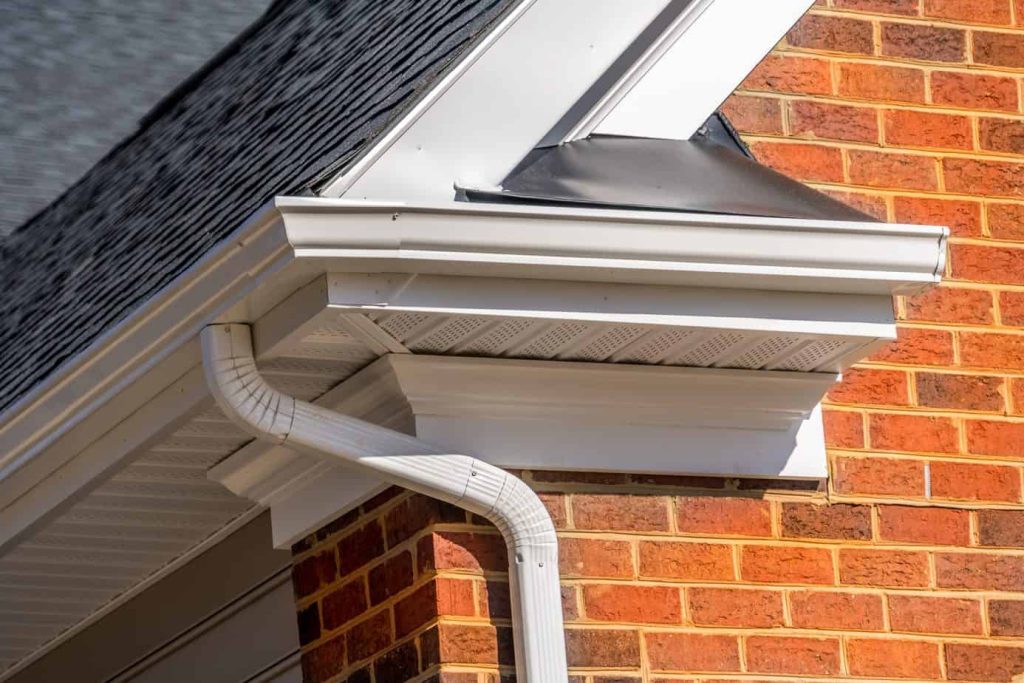
Short Answer: Most residential homes do well with either a 5-inch or 6-inch gutter, depending on roof size, pitch, and local rainfall. The 5-inch K-style gutter is the most common choice for standard homes, while the 6-inch version handles higher water volume on larger roofs or in areas with heavy rainfall.
If you’re replacing old gutters or installing new ones, size matters more than most homeowners realize. Get it wrong, and you’re looking at overflow, water damage, and a system that fails when you need it most. Get it right, and your gutters quietly do their job for years without you thinking about them. This guide walks you through everything you need to know to choose the right gutter size for your home.
Why Gutter Size Matters
Your gutter system is your roof’s drainage line. When rain falls, water runs down your roof’s surface and into the gutters, which then channel it toward the downspouts and away from your foundation. When a gutter is too small for the volume of water coming off your roof, it overflows, pooling against your foundation, damaging your siding, eroding landscaping, and eventually finding its way into your basement.
Oversized gutters aren’t always the answer either. Wider gutters collect more debris, are heavier when full, and can hold standing water longer, which accelerates corrosion and creates a habitat for pests. The goal is to match your gutter sizing to your specific roof area, pitch, and local rainfall intensity.
K-Style Gutters
K-style gutters (sometimes called ogee gutters) have a flat back, a decorative front profile, and a flat bottom. They hold more water per inch of width than other gutter styles because of their flat bottom.
K-style gutters work well for:
- Modern or contemporary homes
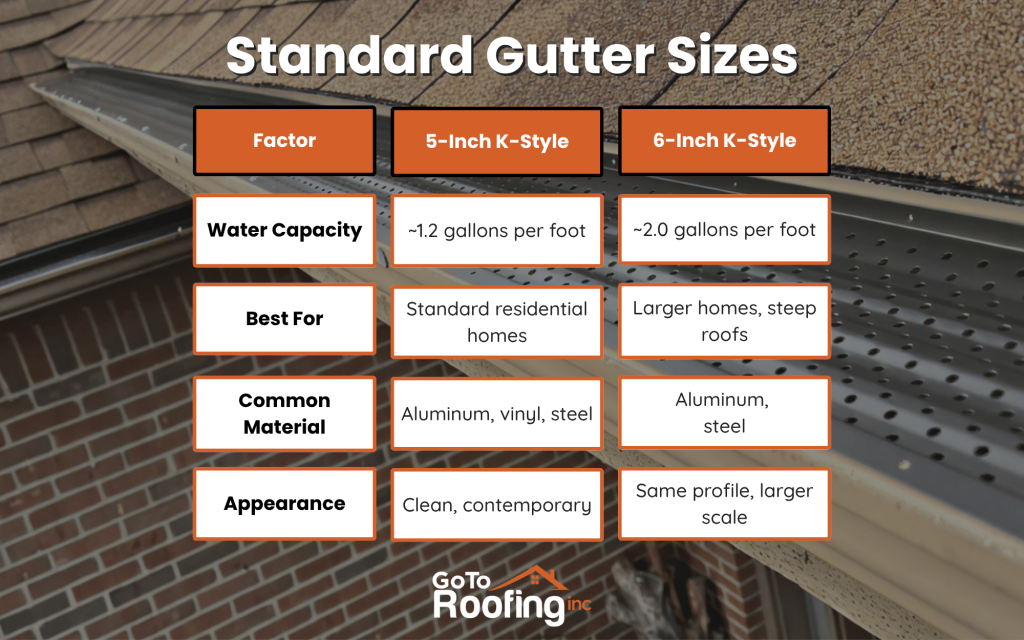
- Higher water volume needs (5-inch holds ~1.2 gal/ft, 6-inch holds ~2.0 gal/ft)
- Homeowners wanting the widest material selection: aluminum, vinyl, and steel
Gutter Sizes
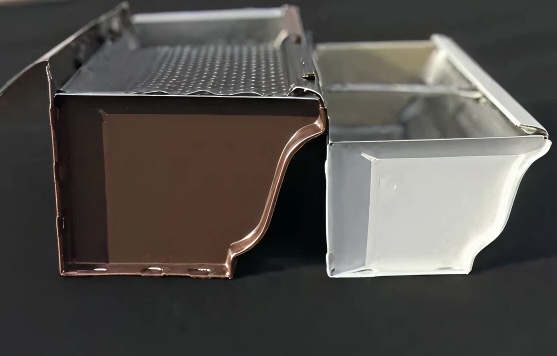
For residential gutters in the U.S., you’ll encounter two main sizes: 5-inch and 6-inch. These measurements refer to the width of the gutter opening.
5-Inch Gutters
The 5-inch gutter is the most common size on residential homes, and is widely available in aluminum, vinyl, and steel.
5-inch gutters work well for:
- Homes with smaller roof areas (under 1,000–1,200 sq. ft. of drainage per section)
- Low to moderate roof pitch
- Areas with moderate rainfall
- Standard residential neighborhoods
6-Inch Gutters
The 6-inch gutter moves roughly 40% more water than a 5-inch version, and for some homes, that difference is the line between a system that works and one that overflows.
6-inch gutters work well for:
- Larger homes with more roof area (over 1,200 sq. ft. of drainage per section)
- Steep roof pitch (steep roofs shed water faster, increasing flow rate)
- Regions with intense or frequent rain
- Commercial buildings or structures with high water volume
How to Calculate the Right Gutter Size
Choosing the right gutter size isn’t guesswork. It’s a calculation based on three factors:
- Roof area (in square feet)
- Roof pitch
- Maximum rainfall intensity for your region

Step 1: Determine Your Drainage Area
The drainage area is the footprint of your roof section that drains into a single gutter run (one continuous length of gutter that carries water to a single downspout). For a simple gable roof, the drainage area is half of your total roof square footage.
Step 2: Adjust for Roof Pitch
Steeper roofs move water faster, which means a higher volume hits the gutter in a shorter window. Adjusting for pitch is standard practice under the International Plumbing Code, which requires gutters to be sized based on actual flow rate from the roof surface. Use the multipliers below to adjust your drainage area:
| Roof Pitch | Pitch Factor |
|---|---|
|
Flat to 3/12
|
1.0
|
|
4/12 to 5/12
|
1.05
|
|
6/12 to 8/12
|
1.1
|
|
9/12 to 11/12
|
1.2
|
|
12/12 and steeper
|
1.3
|
Multiply your drainage area by the pitch factor to get your adjusted roof area.
Step 3: Factor in Rainfall Intensity
Rainfall intensity is measured in inches per hour. The National Oceanic and Atmospheric Administration (NOAA), sometimes called the atmospheric administration, publishes intensity maps by region.
For most of the Midwest, gutters are typically sized to handle 3 to 4 inches of rain per hour, which covers most storms in the region, though some areas can see heavier short bursts.
Step 4: Match to a Gutter Size
Use this general reference guide based on adjusted roof area and rainfall intensity:
| Adjusted Roof Area (sq. ft.) | Rainfall Intensity | Recommended Size |
|---|---|---|
|
Up to 800
|
2–3 in./hr
|
4-inch (rare; smaller homes)
|
|
800–1,200
|
3–4 in./hr
|
5-inch K-style
|
|
1,200–2,000
|
3–5 in./hr
|
6-inch K-style
|
|
2,000+
|
Any
|
6-inch K-style or auxiliary gutter
|
If you’re unsure where your home falls, a professional gutter installer can run these numbers for you and account for any variables specific to your roof layout.
Downspout Size Matters Too
The downspout is also an integral part of the system. A well-sized gutter can still overflow if the downspout can’t move water out fast enough.
- 5-inch gutters typically pair with a 2×3-inch or 3-inch round downspout
- 6-inch gutters typically pair with a 3×4-inch or 4-inch round downspout
As a general rule, you need at least one downspout for every 30–40 linear feet of gutter. On longer runs or areas with heavy rain, spacing them closer, every 20 feet, provides better protection.
Material Options for Your New Gutters
Gutter size and style are just part of the decision. Material affects longevity, appearance, and cost.

Vinyl is the most budget-friendly material, typically lasting 10 to 20 years. It installs easily and won’t rust, but it can become brittle and crack in cold climates, making it a less reliable long-term choice for Michigan winters.
Galvanized steel is heavier and more rigid, lasting 15 to 25 years, but it becomes more susceptible to rust as the protective coating wears down.
Copper is the premium option at 50 or more years, never needs painting, and develops a natural patina over time, though it runs significantly more than aluminum or steel.
For most homeowners in the Ann Arbor area, seamless aluminum hits the best balance of cost, longevity, and low maintenance. It typically lasts 20 to 30 years, resists rust, and can be painted to match your home’s exterior, making it the most practical choice for Michigan’s climate.
Should You Add a Gutter Guard?
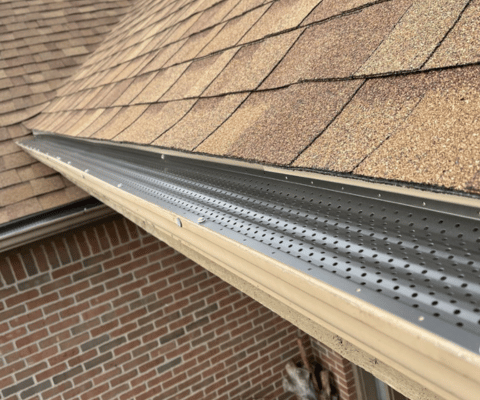
Once you’ve chosen the right gutter size, a gutter guard can protect that investment by reducing how often debris clogs the system, especially for homes with trees nearby or overhanging the roofline. Gutter guards don’t eliminate maintenance entirely, but they do reduce frequency, and adding them at the time of installation lowers the overall cost since the labor overlaps.
Common Mistakes When Choosing Gutter Size
- Going with the smallest size to save money. Undersized gutters overflow in heavy rain, causing the exact water damage they’re supposed to prevent.
- Ignoring roof pitch. Steeper roofs shed water fast. A 5-inch gutter on a 12/12 pitch roof may be overwhelmed even on a mid-sized home.
- Forgetting about downspout capacity. Wider gutters paired with undersized downspouts create a bottleneck.
- Using the wrong style for the home. K-style on a Victorian, can hurt curb appeal and resale value.

When to Call a Professional
A professional gutter installer brings more than just labor. They will measure your actual roof pitch, check your fascia for rot or damage, and make sure the gutter run is sloped correctly for drainage. Even a perfectly sized gutter won’t drain well if it’s pitched the wrong way. If you’re replacing gutters alongside a roof, siding, or fascia project, having one team handle everything avoids scheduling headaches and ensures it all ties together.
At GoTo Roofing, we help homeowners in Ann Arbor and the surrounding communities with gutter installation, roof replacement and repair, siding, windows, and attic insulation. Our team stays hands-on through the full project, uses American-made materials, and stands behind our work long after the job is done. If your current gutters aren’t keeping up or you’re not sure what size your home needs, contact us today for a free estimate.
Copyright © 2026 WebLocal, Inc.