
Roof Ventilation Explained: Why It Matters More Than People Think

Short Answer: Roof ventilation moves fresh air through your attic using a balanced system of intake vents (usually soffit vents at the eaves) and exhaust vents (usually a ridge vent at the peak). Proper attic ventilation keeps hot air and moist air from building up under your roof deck, which protects your shingles, prevents ice dams, controls moisture buildup, and can even lower your energy bills.
When homeowners think about their roof, they usually picture shingles, gutters, and maybe flashing. Ventilation rarely makes the list. A roof that cannot breathe traps heat and moisture, and both of those will cause damage long before the shingles themselves wear out, ultimately shortening the life of your roof.
This guide covers how roof ventilation works, why it matters in both summer and winter, the types of vents available, and what to know if you are thinking about adding roof ventilation to your home.
How Roof Ventilation Works
Roof ventilation is built on a simple principle: hot air rises. A well-designed ventilation system takes advantage of that natural airflow by giving air a low place to enter and a high place to exit.
- Intake vents sit low, usually as soffit vents under the eaves. They pull in cooler outside air.
- Whereas exhaust vents sit high, usually as a ridge vent along the peak of the roof line. They let warm air escape.
As warm air exits through the exhaust vent, it draws fresh air in through the intake vent below. This continuous cycle keeps air moving across the underside of the roof sheathing, carrying heat and moisture out of the attic space before they can cause trouble.
The key is balance. Intake and exhaust need to work together. An attic with plenty of exhaust ventilation but blocked or missing air intake cannot move air effectively. In some cases, an unbalanced system will pull air from the wrong places, such as conditioned living space or even through the exhaust vent itself.
Why Ventilation Matters
Summer Heat Buildup Cooks Your Roof
On a 90-degree day, the attic temperature can climb past 150 degrees without proper ventilation. That trapped hot air does real damage. Asphalt shingles are baked by the heat from both the sun and the roof deck, causing shingle wear. This can accelerate aging and shorten the life of your roofing material.
Improper ventilation can also cause higher cooling costs. A scorching attic radiates heat down into your living space, forcing your air conditioner to run longer. Good airflow, paired with solid attic insulation and possibly a radiant barrier, keeps that heat out of your home and helps control energy bills.
Heat takes a toll on the roof deck itself, too. When roof sheathing bakes at high temperatures month after month, the plywood or OSB panels can warp, and the adhesives holding their layers together can start to break down. Once the decking delaminates, it loses strength and no longer gives your shingles a flat, solid surface to grip.
Winter Brings Moisture Problems and Ice Dams
Here in Michigan, the winter months are when good ventilation matters most. Everyday activities like cooking, showering, and doing laundry release water vapor into your home. That moist air rises, and without proper ventilation, it collects in the attic. When warm, humid air rises to the attic and hits the cold underside of the roof deck, it condenses. Over time, that condensation leads to moisture buildup, wet insulation, mold growth, and rotting wood.
Ventilation also plays a leading role in ice dam prevention. An ice dam forms when heat trapped in the attic melts snow on the upper roof, and the meltwater refreezes at the eaves. Proper attic ventilation keeps the entire roof surface closer to the outside temperature in a cold climate. This allows snow to melt evenly instead of creating an ice ridge at the edge.
Types of Roof Vents
Every roof vent falls into one of two categories: intake or exhaust. Here are the most common options.
| Vent Type | Category | Where It Goes | Best For |
|---|---|---|---|
|
Soffit vents
|
Intake
|
Under the eaves
|
Nearly every home; the standard intake option
|
|
Ridge vent
|
Exhaust
|
Along the roof peak
|
Continuous, low-profile exhaust on most shingle roofs
|
|
Gable vent
|
Intake/Exhaust
|
In the gable wall near the peak
|
Older homes; works best without a ridge vent
|
|
Box (static) vents
|
Exhaust
|
Near the ridge
|
Roofs where a ridge vent is not practical
|
|
Attic fan
|
Exhaust
|
Roof or gable
|
Attics that need mechanical help moving air
|
|
Turbine vents
|
Exhaust
|
Near the ridge
|
Wind-driven exhaust without electricity
|
A Note on Mixing Vent Types
More vents are not automatically better. When two different exhaust vents sit at different heights, air can short-circuit between them. For example, having both a ridge vent and a gable vent can cause the ridge vent to pull its air from the nearby gable vent instead of drawing fresh air up through the soffits below. Then the lower portion of the attic barely ventilates at all, and the system underperforms even though the roof looks well-ventilated. This is one reason a professional assessment matters before adding roof ventilation to an existing roof.
How Much Ventilation Does Your Roof Need?
Building codes and shingle manufacturers generally follow the 1:300 rule: 1 square foot of net free vent area , meaning the unobstructed opening that actually lets air through, for every 300 square feet of attic floor, as long as the ventilation is balanced between intake and exhaust and the home has a vapor retarder. Without one, the requirement doubles to 1:150.
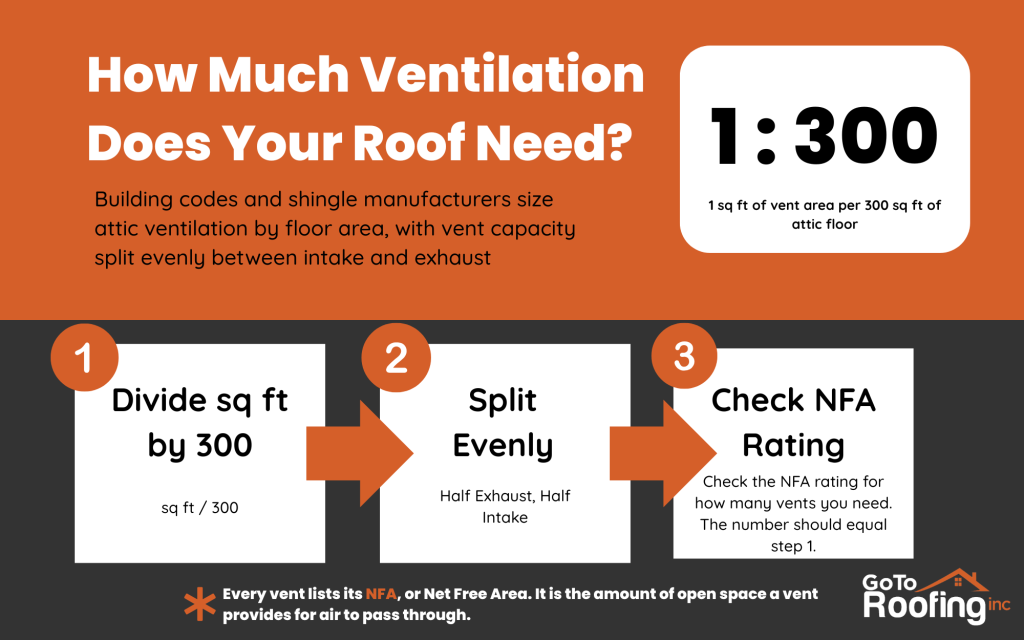
Square footage math only tells part of the story. Vent placement, roof shape, and obstructions all affect real-world performance, which is why two attics with identical measurements can ventilate very differently.
How to Tell If Your Attic Is Not Getting Enough Air
Ventilation problems rarely announce themselves. Because everything happens inside the attic space, most homeowners have no idea anything is wrong until damage shows up somewhere else in the home. The good news is that a struggling ventilation system leaves clues, and you do not need to be a roofer to spot them. Some show up on your energy bills, some show up on your shingles, and some are hiding in plain sight the next time you open the attic hatch.
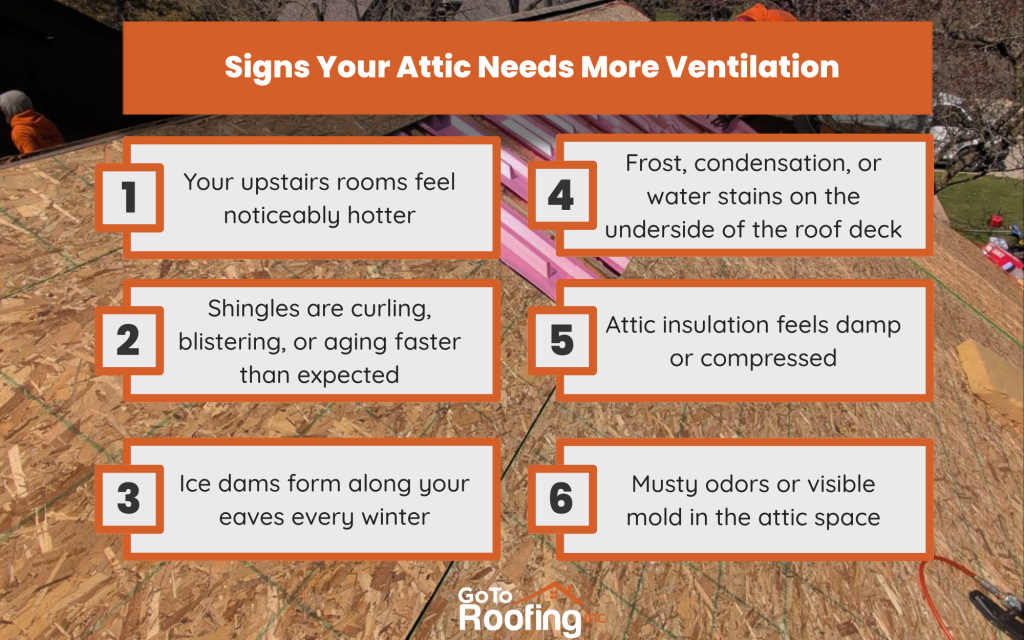
One of these signs on its own does not always mean trouble. Shingles age for plenty of reasons, and a warm bedroom in July is not unusual. But when two or three of these show up together, poor airflow is the likely thread connecting them.
Adding Roof Ventilation to an Existing Roof
You do not have to wait for a roof replacement to fix a ventilation problem. Additional vents can be added to most existing roofs. The typical process looks like this:
Assess what you have: A roofer measures your attic, checks existing intake and exhaust, and looks for blocked soffit vents. Insulation pushed tight against the eaves is one of the most common problems we find, and baffles can restore that air intake without new ventilation holes.
Balance intake first: If the assessment reveals an intake problem, fix that before anything else. Adding or clearing soffit vents often does more good than adding another exhaust vent up top.
Add exhaust strategically: Cutting in a ridge vent is usually the cleanest solution on a shingle roof. Box vents or an attic fan may make sense on roofs with short ridge lines.
Address related issues: Because ventilation, attic insulation, and air sealing work as one roof assembly, fixing one without the others often leaves performance on the table. Sealing air leaks and topping up insulation at the same time gives you the full benefit.
If your roof is already due for replacement, that is the ideal time to get ventilation right. Installing a new roof lets your contractor cut in a continuous ridge vent or individual box vents, correct soffit problems, and design a balanced ventilation system without working around existing shingles.

A Small Detail With a Big Payoff
Roof ventilation is easy to overlook because it works quietly in the background. However, a well-ventilated roof lasts longer, resists ice dams, keeps moisture out of your insulation, and takes a load off your heating and cooling system. Compared to the cost of premature roof repairs or a moldy attic, getting ventilation right is one of the smartest investments a homeowner can make.
At GoTo Roofing, we help homeowners in Ann Arbor and the surrounding communities solve ventilation problems at the source. Our team handles roof repair, roof replacement, siding, windows, gutters, and attic insulation, and we stay hands-on with on-site supervision through the whole project. We give you straightforward guidance on what your roof needs. Contact us today for a free estimate and find out how much a properly ventilated roof can do for your home.
Copyright © 2026 WebLocal, Inc.