
Understanding the Different Types of Roofing Warranties
Short Answer: Most roofs come with two or three warranties, and each one protects a different part of the job. A manufacturer’s material warranty covers defective materials like shingles or flashing, while a workmanship warranty covers installation errors from your roofing contractor. A manufacturer’s system warranty goes further, covering both materials and labor when a certified contractor installs an approved roofing system. To keep any of them valid, it helps to read the fine print and choose a reputable contractor from the start.
A new roof is a big investment, so it helps to understand what protects it after the job is done. This guide breaks down the main types of roofing warranties, what they cover, what they leave out, and how to keep your coverage in good standing.
Why Roofing Warranties Matter
A roofing warranty is a promise that someone will fix or pay for certain problems if they show up. That “someone” might be the roofing manufacturer that made your roofing material, or the roofing company that installed it. Knowing who is responsible for what helps you avoid scrambling if a roof leak appears.
Three warranties exist because different parties stand behind different risks. A material defect is the manufacturer’s responsibility, installation errors fall on the contractor, and a system warranty rolls both into one plan backed by the manufacturer. That separation works in your favor: if something fails, you have a clear path to a repair or replacement without paying out of pocket, as long as the coverage is still valid.
The Main Types of Roofing Warranties
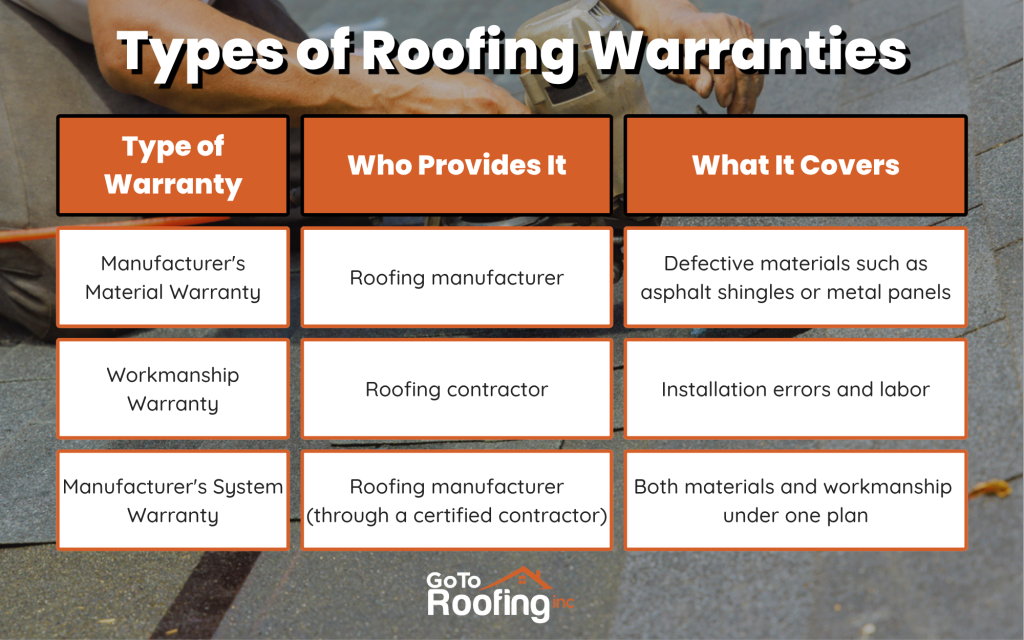
Most residential roofing projects involve the three types of warranties mentioned above. This table is a quick overview of each before we look at them in more detail.
Manufacturer’s Material Warranty
A manufacturer’s material warranty covers the roofing material itself. If your asphalt shingles crack, blister, or fall apart because of defective materials, this warranty is what you fall back on. The same idea applies to a metal roof, where the manufacturer’s warranty covers the panels and finishes against defects such as premature rust or corrosion.
Most shingle manufacturers include a basic limited lifetime warranty on their products. “Limited lifetime” sounds generous, but it has conditions worth understanding:
- Coverage usually applies for the life of the shingle, which is determined by the manufacturer, not literally forever.
- The strongest protection often applies only during an early period, sometimes the first 10 to 15 years.
- After that period, coverage is prorated, meaning the payout drops each year as the roof ages.
A limited lifetime warranty typically pays for the cost of the replacement roofing material, but not always the labor to install it. That distinction surprises a lot of homeowners, so check how labor is handled before assuming you are fully covered.
Workmanship Warranty
A workmanship warranty comes from your roofing contractor rather than the manufacturer. It covers mistakes made during installation, such as improperly sealed flashing, popped nails, or a roof leak caused by improper installation.
This type of warranty matters because even the best roofing material will fail if it is installed incorrectly. In fact, installation errors cause more roof problems than material defects do. A solid workmanship warranty shows that the roofing company is willing to stand behind its labor.
Workmanship warranty length varies widely:
- Some contractors offer 1 to 2 years.
- Reputable contractors often offer 10 years or more.
Because this warranty depends entirely on the company that issued it, it is only as good as the contractor behind it. A workmanship warranty from a business that closes next year will not help you much, which is one more reason to hire a reputable roofing contractor with a track record in your area. At GoTo Roofing, we refer to our workmanship warranty as our No-Leak Guarantee. The length of our No-Leak Guarantee begins at 10 years and goes up from there, depending on the roofing system installed.
Manufacturer’s System Warranty
A manufacturer’s system warranty, often marketed as an extended warranty, is the broadest option. Every roofing manufacturer backs its products with a material warranty, but only some go a step further and add labor coverage. A system warranty is that upgrade. Instead of covering materials alone, it covers the entire roofing system, including materials and workmanship, under a single plan from the roofing manufacturer.
There is a catch. To qualify, the roof usually must be installed by a certified contractor who has been trained and approved by that manufacturer, using a full set of approved components. Because the manufacturer is trusting the installation to one of its certified contractors, it is willing to cover labor, too.
System warranties often provide:
- Longer non-prorated coverage periods.
- Protection for both defective materials and installation errors.
- Coverage that can include tear-off and disposal during a repair.
These warranty options usually come at an additional cost, and not every manufacturer offers them. GoTo Roofing is certified to install shingles from every manufacturer, and shingles from Malarkey, Owens Corning, Atlas, and F-Wave (REVIA) also include that added workmanship coverage on top of their standard material warranty.
What Roofing Warranties Usually Do Not Cover
No warranty covers everything. Knowing the common exclusions helps you avoid a denied claim later.
- Severe weather: Damage from extreme weather events like hail, high winds, or fallen trees is normally handled by your homeowners insurance, not your roofing warranty.
- Improper installation under a material-only warranty: If the materials are fine but the installation was wrong, the manufacturer’s material warranty will not pay. That gap is exactly what a workmanship warranty fills.
- Lack of maintenance: Skipping basic roof repair and upkeep can void coverage.
- Poor ventilation: Many manufacturers require proper attic ventilation and may deny claims if it is missing.
- Layering over an old roof: Installing a new roof over existing shingles can reduce or cancel warranty coverage.
- Satellite or solar panels: Installations that attach to the roof will cancel your warranty coverage.
Many warranties also include a dollar limit, meaning the manufacturer will only pay up to a set amount. Reading the fine print is the only way to know your real warranty coverage.
Transferable Warranties and Selling Your Home
If you might sell your home in the near future, a transferable warranty is worth asking about. A transferable warranty lets you pass coverage to the next owner, and can add value when selling your home. Many warranties allow one transfer within a set window, often the first few years after the roof replacement. The terms vary by roofing manufacturer, so confirm the rules before you count on it.
How to Protect Your Roofing Warranty
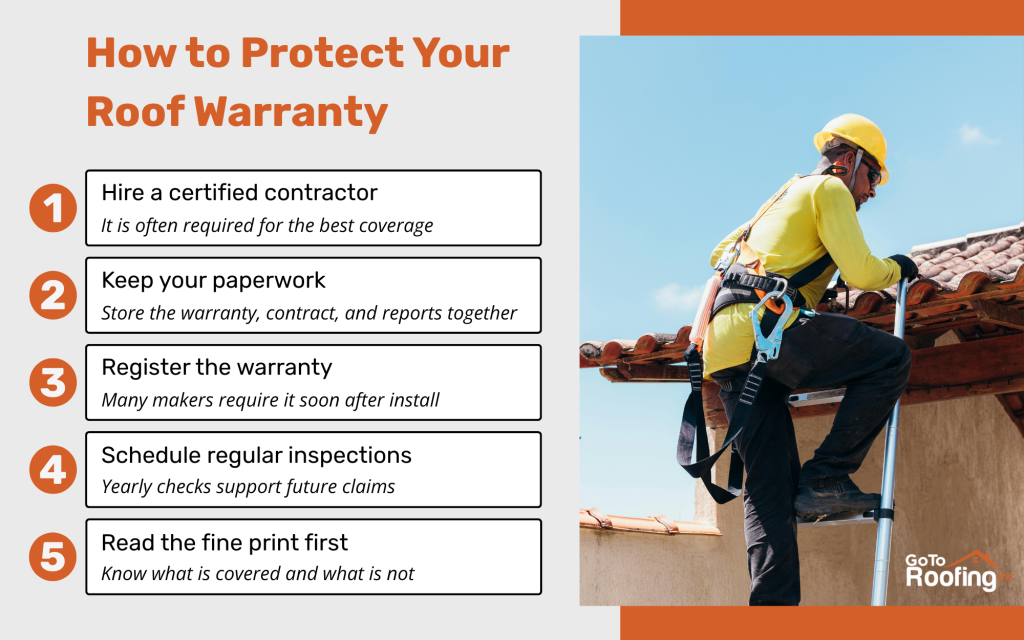
A warranty only helps if you keep it valid. A few habits go a long way:
- Hire a certified contractor. System warranties and the best workmanship coverage usually require a manufacturer-approved installer.
- Keep your paperwork. Save the warranty documents, your contract, and any inspection reports in one place.
- Register the warranty. Some manufacturers require you to register the new roof within a set number of days after installation. GoTo Roofing registers these on the customer’s behalf.
- Schedule regular inspections. Annual checks and prompt roof repair show you maintained the roof, which supports any future claim.
- Read the fine print before you sign. Ask your contractor to walk you through what is covered, what is excluded, and how long each warranty lasts.
Choosing a reputable contractor is the single most important step. A certified, experienced roofing contractor reduces the chance of installation errors in the first place and makes the warranty behind your roof far more reliable.
Protect Your Investment With a Team You Can Trust
Understanding the types of roofing warranties puts you in control of your roofing project. When you know the difference between a material warranty, a workmanship warranty, and a full system warranty, you can compare your options with confidence and pick the coverage that fits your home and budget.
A material warranty means little if the installer voids it, and a system warranty only exists when a manufacturer trusts the crew doing the work. That is the standard GoTo Roofing holds itself to for homeowners in Ann Arbor and the surrounding communities, with American-made materials and whole-project on-site supervision on every roof replacement and repair. If you want straightforward guidance on the right roofing system and the coverage behind it, contact us today for a free estimate.
Copyright © 2026 WebLocal, Inc.